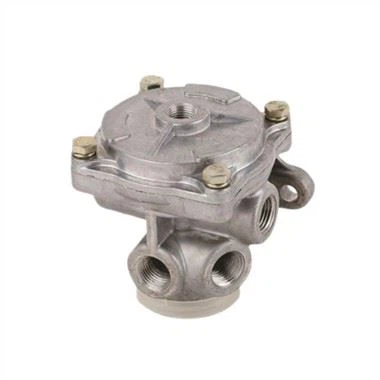
The master brake booster, also known as the brake servo or power brake booster, is a critical component in modern vehicle braking systems. Its primary function is to amplify the force applied to the brake pedal by the driver, making it easier to stop the vehicle and improving braking efficiency. Different types of boosters exist, each leveraging various power sources (e.g., vacuum, hydraulic pressure, or electricity) to achieve this assistance. Below is a detailed explanation of how the most common types work, along with their core mechanisms and operational principles.
### 1. Vacuum Brake Booster: The Most Common Design
Structure and Key Components
A vacuum brake booster typically consists of:
Diaphragm: A flexible membrane that separates the booster into two chambers.
Vacuum Chamber: Connected to the engine's intake manifold (or a vacuum pump) to maintain negative pressure.
Atmospheric Chamber: Sealed but can admit air when the brake pedal is pressed.
Valve Assembly: Includes a vacuum valve and an atmospheric valve, controlled by the brake pedal input.
Pushrod: Transmits the force from the diaphragm to the brake master cylinder.
Working Principle
Resting State (Pedal Not Pressed):
The vacuum valve is open, allowing both chambers to maintain equal vacuum pressure (approx. -20 inHg) from the engine.
The diaphragm remains balanced, exerting no additional force on the master cylinder.
When the Brake Pedal Is Pressed:
Step 1: Valve Activation: The pedal movement triggers a mechanical linkage that closes the vacuum valve and opens the atmospheric valve.
Step 2: Pressure Differential: The atmospheric chamber now admits air (at ambient pressure), while the vacuum chamber retains its negative pressure. This creates a pressure difference across the diaphragm.
Step 3: Diaphragm Movement: The pressure difference (atmospheric pressure pushing on one side of the diaphragm) generates a force that pushes the diaphragm toward the vacuum chamber.
Step 4: Force Amplification: The diaphragm's movement is transferred via the pushrod to the master cylinder, multiplying the driver's foot force by 5-10 times. For example, a 50-pound foot force might become 250-500 pounds of force on the master cylinder.
When the Brake Pedal Is Released:
The vacuum valve reopens, equalizing pressure in both chambers. The diaphragm returns to its resting position, and the booster stops assisting.
Vacuum Source Variations
Gasoline Engines: Rely on intake manifold vacuum, which is abundant during normal operation.
Diesel Engines/Some Hybrids: May use an electric vacuum pump (e.g., a diaphragm pump) to generate vacuum, as diesel engines produce little intake vacuum.
### 2. Hydro-Boost Brake Booster: Hydraulic Assistance for High-Pressure Systems
Structure and Key Components
Hydraulic Chamber: Powered by the vehicle's power steering pump (or a dedicated hydraulic pump).
Piston and Valve Assembly: Controlled by the brake pedal to direct hydraulic pressure.
Pushrod: Transmits hydraulic force to the master cylinder.
Working Principle
Power Source: The power steering pump creates high-pressure hydraulic fluid (typically 1,000-1,500 PSI).
Pedal Application: Pressing the brake pedal activates a valve that directs hydraulic fluid to the booster's piston.
Force Amplification: The hydraulic pressure pushes the piston, which in turn pushes the master cylinder with significant force (e.g., 10-20 times the driver's foot pressure).
Advantages: Ideal for vehicles with limited vacuum (e.g., diesel trucks, heavy-duty vehicles) or those requiring high braking force, as hydraulic pressure is more consistent than engine vacuum.
### 3. Electronic Brake Booster (E-Boost): Modern Electric Assistance
Structure and Key Components
Electric Motor: Driven by the vehicle's electrical system.
Mechanical Transmission: Such as a gear train or screw mechanism to convert motor rotation into linear force.
Control Module: Processes brake pedal input and activates the motor based on driving conditions.
Working Principle
Pedal Input Sensing: Sensors measure the force and travel of the brake pedal.
Electronic Processing: The control module calculates the required assistance based on factors like vehicle speed, load, and ABS activation.
Motor Activation: The electric motor drives a mechanical system (e.g., a screw jack) to push the master cylinder, providing precise and adjustable assistance.
Advantages:
Ideal for electric vehicles (EVs) that lack an engine for vacuum or hydraulic power.
Enables regenerative braking integration, as the system can coordinate between friction brakes and regenerative braking to maximize energy recovery.
Offers faster response times and more consistent performance compared to traditional boosters.
### 4. How Boosters Improve Braking Efficiency: The Physics Behind the Mechanism
Force Multiplication: The core purpose of any booster is to reduce driver effort. Without a booster, stopping a vehicle would require extremely high foot pressure (e.g., 200+ pounds), which is impractical and unsafe.
Example with Vacuum Booster:
The diaphragm area in a typical booster might be 10 square inches.
At standard vacuum (-20 inHg), the pressure difference is ~10 PSI (atmospheric pressure is ~14.7 PSI at sea level, so vacuum of -20 inHg ≈ 5 PSI absolute, leading to a 9.7 PSI difference).
Force from pressure difference: 10 sq. in. × 9.7 PSI = ~97 pounds of assist force, added to the driver's foot pressure.
Safety Criticality: Boosters ensure that even drivers with limited strength can apply sufficient braking force, especially in emergency stops.
### 5. Key Differences Between Booster Types
| Type | Power Source | Common Applications | Advantages |
|---|---|---|---|
| Vacuum Booster | Engine vacuum or electric pump | Most passenger cars, gasoline engines | Simple design, reliable, low maintenance |
| Hydro-Boost | Power steering hydraulic fluid | Diesel trucks, heavy vehicles, some commercial vehicles | Consistent power regardless of engine load, high force output |
| Electronic Booster | Electric motor | EVs, modern hybrids, advanced passenger cars | Compact, integrates with electronic safety systems (ABS, ESC), regenerative braking compatibility |
### 6. Real-World Operation: From Pedal to Stop
Driver Presses Pedal: Mechanical force is applied to the booster's input rod.
Booster Activates: Depending on the type, vacuum pressure, hydraulic fluid, or an electric motor generates assist force.
Master Cylinder Pushed: The combined driver and booster force pushes the master cylinder piston, creating hydraulic pressure.
Hydraulic Pressure Transmitted: Fluid travels to brake calipers/drums, activating the friction components to stop the vehicle.