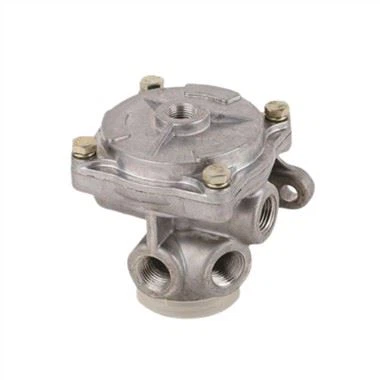
An air brake booster, also known as a pneumatic brake booster, is a specialized component designed to amplify braking force using compressed air. Primarily used in heavy-duty vehicles like trucks, buses, and commercial trailers, it addresses the challenge of stopping large, high-mass vehicles by leveraging pneumatic pressure-an efficient power source in such applications. Below is a detailed breakdown of its structure, working principles, and operational cycles.
### 1. Core Components of an Air Brake Booster
1.1 Pressure Chamber System
Air Supply Reservoir: Stores compressed air (typically 100–150 PSI) from the vehicle's air compressor.
Control Valve: Regulates air flow based on brake pedal input.
Power Piston and Diaphragm: A large-diameter component that converts air pressure into mechanical force.
Pushrod Assembly: Transmits the amplified force to the brake master cylinder or brake chambers.
1.2 Control Mechanism
Brake Pedal Linkage: Mechanical connection between the driver's pedal and the control valve.
Air Lines and Fittings: Pneumatic tubing that carries compressed air to and from the booster.
Check Valve: Prevents air backflow and maintains reservoir pressure.
### 2. Working Principle: From Air Pressure to Braking Force
2.1 Resting State (Pedal Not Depressed)
Valve Position: The control valve blocks air from entering the power piston chamber, maintaining equal air pressure on both sides of the diaphragm (or piston).
Mechanical Balance: The pushrod remains in a neutral position, exerting no force on the brake system.
Air Supply: The reservoir maintains constant pressure, ready for activation.
2.2 Activating the Brake Booster (Pedal Depressed)
Step 1: Control Valve Activation
Pressing the brake pedal triggers a mechanical linkage that opens the control valve.
This allows compressed air from the reservoir to flow into the power piston chamber (one side of the diaphragm/piston).
Step 2: Pressure Differential Creation
Power Chamber: Air pressure (e.g., 100 PSI) pushes against the piston or diaphragm.
Opposite Chamber: Remains at lower pressure (or is vented to the atmosphere), creating a pressure difference.
The larger the piston/diaphragm area, the greater the force amplification (e.g., a 10-inch diameter piston has ~78.5 square inches, generating ~7,850 pounds of force at 100 PSI).
Step 3: Force Transmission to Brakes
The piston's movement drives the pushrod, which acts on the brake master cylinder (in a hydraulic system) or directly on air brake chambers (in pure pneumatic systems).
In hydraulic systems, the pushrod multiplies the driver's foot force and converts it into hydraulic pressure for brake calipers/drums.
In pneumatic systems, the pushrod may activate relay valves that send air to wheel brake chambers, expanding brake shoes or calipers.
2.3 Modulating Brake Pressure (Partial Pedal Depress)
The control valve's design allows proportional air flow: deeper pedal depression opens the valve more, admitting more air and increasing braking force.
This "modulating" capability is crucial for heavy vehicles, enabling drivers to apply precise braking force based on load and road conditions.
### 3. Air Brake Booster vs. Vacuum/Hydro-Boost: Key Differences
| Feature | Air Brake Booster | Vacuum Booster | Hydro-Boost |
|---|---|---|---|
| Power Source | Compressed air (100–150 PSI) | Engine vacuum (-20 inHg ~ 5 PSI) | Hydraulic fluid (1,000–1,500 PSI) |
| Typical Application | Heavy trucks, buses, trailers | Passenger cars, light trucks | Medium-duty trucks, diesel vehicles |
| Force Amplification | High (10–20x driver force) | Moderate (5–10x) | High (10–20x) |
| Dependency on Engine | Independent (air stored in reservoirs) | Depends on engine vacuum | Depends on power steering pump |
| Safety Redundancy | Often includes dual air systems | Single vacuum source | Single hydraulic circuit |
### 4. Operational Cycles in Heavy-Duty Vehicles
4.1 Air Compressor Charging
An engine-driven air compressor continuously fills the reservoir to maintain pressure (e.g., 120 PSI).
A pressure switch stops the compressor once the target pressure is reached and restarts it when pressure drops (e.g., below 100 PSI).
4.2 Braking Sequence (Example for a Truck)
Driver Depresses Pedal: Controls the air brake booster's valve.
Air Released to Booster: Compressed air from the reservoir pushes the power piston.
Mechanical Force Transmitted: The pushrod activates the brake master cylinder (if hydraulic) or relay valves (if pneumatic).
Brake Application:
Hydraulic System: Master cylinder sends fluid to wheel brakes, engaging calipers/drums.
Pneumatic System: Relay valves send air to brake chambers, expanding diaphragms that push brake rods and apply shoes/drums.
Pedal Release: The control valve vents air from the booster, allowing the piston to return to its resting position, releasing the brakes.
### 5. Safety Features in Air Brake Systems
5.1 Dual Air Systems
Most heavy vehicles have two independent air systems (front and rear axles) for redundancy. If one fails, the other can still provide braking.
The booster may be connected to both systems to ensure force amplification even in partial failures.
5.2 Parking Brake Integration
Air brake boosters often work in conjunction with spring-loaded parking brakes. When air pressure drops (e.g., during a system failure), the springs apply the brakes automatically (fail-safe design).
5.3 Pressure Gauges and Alarms
Dashboard gauges monitor air reservoir pressure, and alarms sound if pressure drops below a safe threshold (e.g., 60 PSI), warning the driver of potential booster failure.
### 6. Advantages of Air Brake Boosters in Heavy Vehicles
High Force Output: Compressed air provides consistent, high-pressure assistance, essential for stopping heavy loads.
Independence from Engine Load: Unlike vacuum boosters (which rely on engine vacuum), air boosters use stored pressure, making them reliable even during engine stalls or high-load conditions.
Simple Maintenance: Pneumatic components are durable and less prone to fluid leaks compared to hydraulic systems.
Long-Range Operation: Air reservoirs allow multiple brake applications even if the compressor fails, providing a safety buffer.
### 7. Real-World Example: Air Brake Booster in a Semi-Truck
Vehicle Specs: A typical semi-truck with a gross vehicle weight (GVW) of 80,000 lbs.
Booster Design: A dual-diaphragm air booster with a combined area of ~150 square inches.
Force Calculation: At 100 PSI air pressure, the booster generates 150 sq. in. × 100 PSI = 15,000 pounds of force.
Driver Input: The driver may apply 50–100 pounds of foot pressure, which the booster amplifies to 15,000+ pounds, enabling the truck to stop within safe distances.