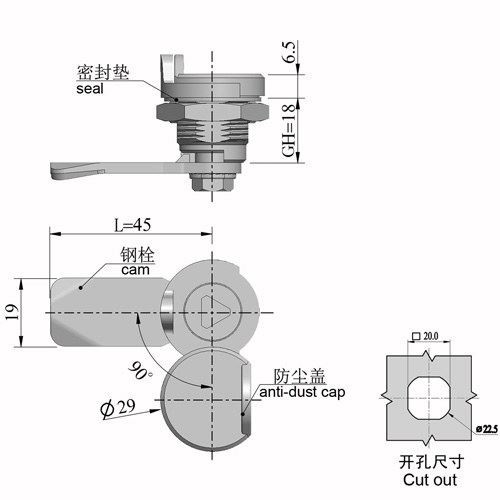
Reputable cylinder lock manufacturers recognize that standard products cannot always meet unique industry or project needs. Most offer a range of customization options to align with specific application requirements, including:
(1) Size and Dimensional Customization
This is the most requested customization, as door thickness, installation space, and matching locksets vary widely. Manufacturers can adjust:
Length and diameter: For example, Euro cylinder locks (common in commercial doors) can be customized from 60mm to 150mm to fit door thicknesses of 35mm–120mm.
Keyway position: Adapting the location of the keyhole (e.g., left-handed, right-handed, or centered) for asymmetric door designs, such as those used in RVs or truck toolboxes.
(2) Functional Customization
To address environmental or usage challenges, manufacturers add specialized features:
Weather resistance: Integrating rubber gaskets or PTFE coatings for cylinder locks used in outdoor scenarios (e.g., garage doors, marine equipment) to prevent water or dust intrusion.
Security enhancements: Adding anti-drill plates (tungsten carbide) for high-risk areas (e.g., bank ATMs) or anti-snap bolts for locks in theft-prone commercial districts.
Access control integration: Modifying cylinders to work with electronic systems (e.g., RFID cards or biometrics) for smart buildings or industrial facilities.
(3) Key System Customization
For enterprises needing centralized access management, manufacturers offer:
Keyed-alike systems: Multiple locks sharing a single key (ideal for office buildings or factories with multiple rooms).
Master-keyed systems: Hierarchical key control (e.g., a "master key" for managers to access all areas, and "sub-keys" for staff to access only their zones).
Restricted keyways: Patented key designs that can only be duplicated with the manufacturer's authorization, preventing unauthorized key copying.
(4) Aesthetic and Material Customization
While function is priority, customization also extends to appearance and materials:
Surface finishes: Options like nickel-plating, brass-plating, or black powder-coating to match the client's equipment or building decor.
Material swaps: Using marine-grade stainless steel (instead of standard steel) for locks in corrosive environments (e.g., coastal warehouses or chemical plants).