


As a reputable supplier of foot brake valves, I often receive inquiries from customers regarding the braking efficiency of different foot brake valve models. In this blog post, I will delve into the factors that influence braking efficiency and compare the performance of various foot brake valve models.
Understanding Braking Efficiency
Braking efficiency is a critical parameter that determines the ability of a vehicle's braking system to slow down or stop the vehicle effectively. It is influenced by several factors, including the design of the brake valve, the type of braking system (e.g., air brake or hydraulic brake), the condition of the brake components, and the operating conditions.
The primary function of a foot brake valve is to control the flow of pressurized fluid (either air or hydraulic fluid) to the brake chambers or calipers, thereby activating the brakes. The efficiency of a foot brake valve can be evaluated based on several key performance indicators, such as response time, pressure build-up rate, and modulation ability.
Response Time
Response time refers to the time it takes for the brake valve to initiate the braking action after the driver presses the brake pedal. A shorter response time indicates a more responsive braking system, which is crucial for ensuring safety, especially in emergency situations.
Different foot brake valve models may have varying response times due to differences in their internal design and construction. For example, some advanced foot brake valves are equipped with quick-release mechanisms or optimized flow paths, which can significantly reduce the response time.
Pressure Build-up Rate
The pressure build-up rate is another important factor that affects braking efficiency. It refers to the rate at which the brake pressure increases after the brake valve is activated. A higher pressure build-up rate allows for faster and more effective braking, especially when a large amount of braking force is required.
The pressure build-up rate is influenced by the size and design of the brake valve, as well as the characteristics of the braking system. Some foot brake valve models are designed to provide a rapid pressure build-up, while others may offer a more gradual increase in pressure for better modulation.
Modulation Ability
Modulation ability refers to the ability of the brake valve to precisely control the amount of braking force applied based on the driver's input. A good foot brake valve should allow the driver to smoothly and accurately adjust the braking force, whether it is a light tap on the brake pedal for normal driving or a hard press for emergency braking.

The modulation ability of a foot brake valve is determined by its internal control mechanism and the quality of its components. Some high-end foot brake valve models are equipped with advanced modulation features, such as proportional control or electronic feedback, which can enhance the driver's control over the braking system.
Comparison of Different Foot Brake Valve Models
Now, let's compare the braking efficiency of different foot brake valve models commonly used in the market.
Model A: Conventional Foot Brake Valve
The conventional foot brake valve is a basic type of brake valve that has been widely used for many years. It typically features a simple mechanical design and is relatively inexpensive. However, its braking efficiency may be limited compared to more advanced models.
The response time of a conventional foot brake valve is usually relatively long, as it relies on mechanical linkages and diaphragms to control the flow of fluid. The pressure build-up rate is also relatively slow, which may result in a delay in braking action. In terms of modulation ability, the conventional foot brake valve may not provide the same level of precision as more advanced models.
Model B: Air Brake Master Cylinder
The Air Brake Master Cylinder is a type of foot brake valve commonly used in air brake systems. It is designed to convert the mechanical force applied by the driver's foot on the brake pedal into hydraulic pressure, which is then used to actuate the air brakes.
Compared to the conventional foot brake valve, the air brake master cylinder generally offers a faster response time and a higher pressure build-up rate. This is because it uses hydraulic fluid to transmit the force, which can provide a more direct and efficient way of activating the brakes. The air brake master cylinder also typically has better modulation ability, allowing the driver to more precisely control the braking force.
Model C: Clutch Master Pump for Truck
The Clutch Master Pump for Truck is another type of foot brake valve that is specifically designed for use in trucks. It is similar to the air brake master cylinder in terms of its function, but it is optimized for the unique requirements of truck braking systems.
The clutch master pump for truck usually features a larger bore size and a higher pressure rating, which allows it to generate more braking force. It also has a more robust construction to withstand the heavy-duty operation of trucks. In terms of braking efficiency, the clutch master pump for truck generally offers a faster response time, a higher pressure build-up rate, and better modulation ability compared to the conventional foot brake valve.
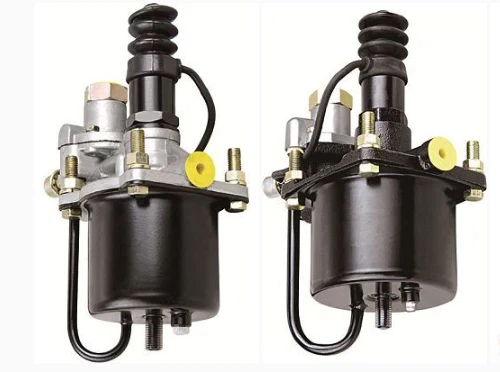
Model D: Hydraulic Clutch Booster
The Hydraulic Clutch Booster is a type of foot brake valve that is used in conjunction with a hydraulic clutch system. It is designed to amplify the force applied by the driver's foot on the clutch pedal, making it easier to engage and disengage the clutch.
Although the primary function of the hydraulic clutch booster is related to the clutch system, it can also have an impact on the braking efficiency of the vehicle. A well-designed hydraulic clutch booster can provide a more consistent and responsive braking feel, as it helps to maintain the proper pressure in the hydraulic system. This can result in a shorter response time and a more effective braking action.
Factors to Consider When Choosing a Foot Brake Valve
When choosing a foot brake valve, it is important to consider several factors to ensure that you select the model that best suits your needs.
Vehicle Type and Application
The type of vehicle and its intended application play a crucial role in determining the appropriate foot brake valve. For example, a heavy-duty truck may require a more powerful and robust foot brake valve compared to a light-duty passenger car. Similarly, a vehicle that is used for frequent stop-and-go driving may benefit from a foot brake valve with better modulation ability.
Braking System Requirements
The requirements of the braking system, such as the type of brake (e.g., disc brake or drum brake), the number of brake chambers or calipers, and the operating pressure, also need to be taken into account. Different foot brake valve models are designed to work with specific braking systems, so it is important to choose a valve that is compatible with your vehicle's braking system.
Performance and Safety
Of course, the performance and safety of the foot brake valve are of utmost importance. Look for a model that offers a fast response time, a high pressure build-up rate, and good modulation ability. Additionally, make sure that the foot brake valve meets all the relevant safety standards and regulations.
Cost and Maintenance
Finally, consider the cost and maintenance requirements of the foot brake valve. While it is important to choose a high-quality valve that offers good performance and safety, you also need to ensure that it fits within your budget. Additionally, look for a valve that is easy to maintain and has a long service life.
Conclusion
In conclusion, the braking efficiency of different foot brake valve models can vary significantly depending on their design, construction, and performance characteristics. When choosing a foot brake valve, it is important to consider factors such as response time, pressure build-up rate, modulation ability, vehicle type and application, braking system requirements, performance and safety, and cost and maintenance.
As a supplier of foot brake valves, we offer a wide range of high-quality products that are designed to meet the diverse needs of our customers. Whether you are looking for a conventional foot brake valve, an air brake master cylinder, a clutch master pump for truck, or a hydraulic clutch booster, we have the right solution for you.
If you are interested in learning more about our foot brake valve products or would like to discuss your specific requirements, please feel free to contact us. Our team of experts will be happy to assist you and provide you with the best possible solution for your braking needs.
References
- SAE International. (2023). SAE J1401: Air Brake System Terminology.
- Bosch. (2023). Brake Systems Handbook.
- Meritor. (2023). Air Brake Systems Manual.


